Showing posts with label dione. Show all posts

Friday, 1 January 2016

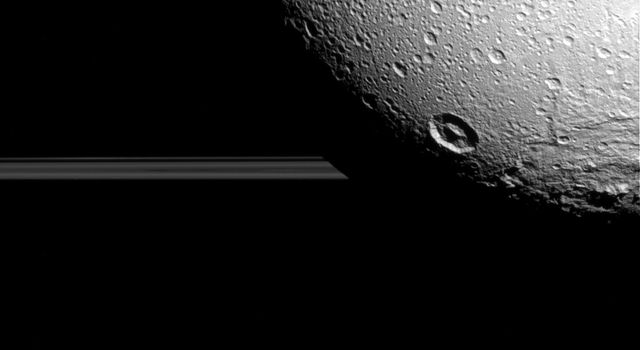
This Photo of Saturn's Moon Dione Crossing the Planet Is Simply Jaw-Dropping (space.com)

Saturn's moon Dione crosses the face of the ringed planet in an image obtained on May 21, 2015

.
Credit: NASA/JPL-Caltech/Space Science Institute

Friday, 21 August 2015

Cassini's Final Breathtaking Close Views of Dione (NASA)


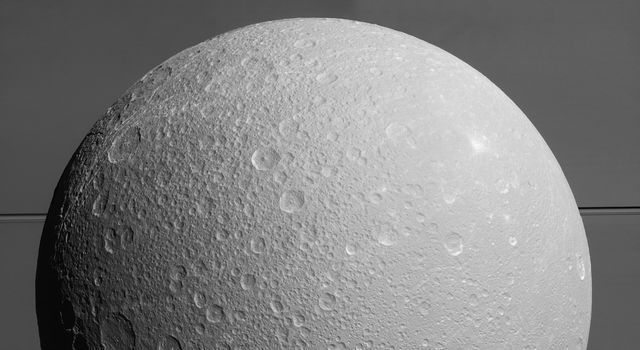
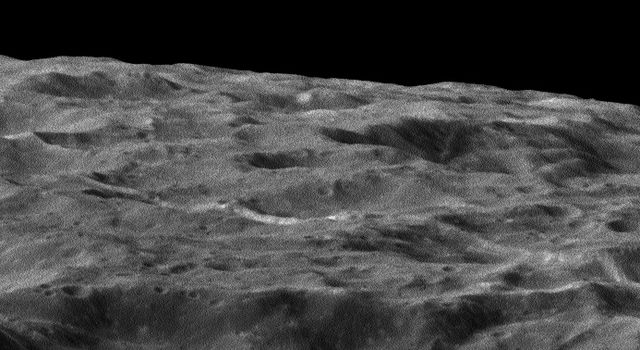
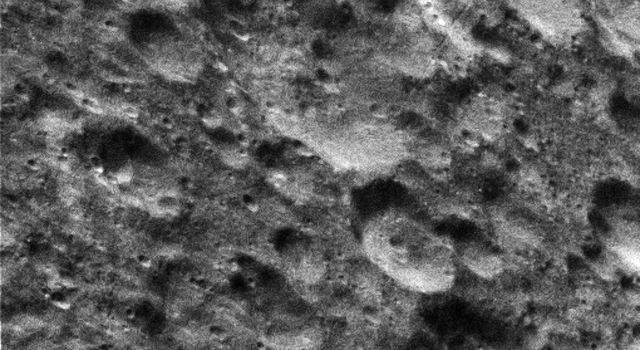
A pockmarked, icy landscape looms beneath NASA's Cassini spacecraft in new images of Saturn's moon Dione taken during the mission's last close approach to the small, icy world. Two of the new images show the surface of Dione at the best resolution ever.
Cassini passed 295 miles (474 kilometers) above Dione's surface at 11:33 a.m. PDT (2:33 p.m. EDT) on Aug. 17. This was the fifth close encounter with Dione during Cassini's long tour at Saturn. The mission's closest-ever flyby of Dione was in Dec. 2011, at a distance of 60 miles (100 kilometers).
"I am moved, as I know everyone else is, looking at these exquisite images of Dione's surface and crescent, and knowing that they are the last we will see of this far-off world for a very long time to come," said Carolyn Porco, Cassini imaging team lead at the Space Science Institute, Boulder, Colorado. "Right down to the last, Cassini has faithfully delivered another extraordinary set of riches. How lucky we have been."
Raw, unprocessed images from the flyby are available at:
http://saturn.jpl.nasa.gov/mission/flybys/dione20150817/
The main scientific focus of this flyby was gravity science, not imaging. This made capturing the images tricky, as Cassini's camera was not controlling where the spacecraft pointed.
"We had just enough time to snap a few images, giving us nice, high resolution looks at the surface," said Tilmann Denk, a Cassini participating scientist at Freie University in Berlin. "We were able to make use of reflected sunlight from Saturn as an additional light source, which revealed details in the shadows of some of the images."
Cassini scientists will study data from the gravity science experiment and magnetosphere and plasma science instruments over the next few months as they look for clues about Dione's interior structure and processes affecting its surface.
Only a handful of close flybys of Saturn's large, icy moons remain for Cassini. The spacecraft is scheduled to make three approaches to the geologically active moon Enceladus on Oct. 14 and 28, and Dec. 19. During the Oct. 28 flyby, the spacecraft will come dizzyingly close to Enceladus, passing a mere 30 miles (49 kilometers) from the surface. Cassini will make its deepest-ever dive through the moon's plume of icy spray at this time, collecting valuable data about what's going on beneath the surface. The December Enceladus encounter will be Cassini's final close pass by that moon, at an altitude of 3,106 miles (4,999 kilometers).
After December, and through the mission's conclusion in late 2017, there are a handful of distant flybys planned for Saturn's large, icy moons at ranges of less than about 30,000 miles (50,000 kilometers). Cassini will, however, make nearly two dozen passes by a menagerie of Saturn's small, irregularly shaped moons -- including Daphnis, Telesto, Epimetheus and Aegaeon -- at similar distances during this time. These passes will provide some of Cassini's best-ever views of the little moons.
During the mission's final year -- called its Grand Finale -- Cassini will repeatedly dive through the space between Saturn and its rings.

Monday, 2 July 2012

Saturn's Icy Moon Dione Has Oxygen Atmosphere


A NASA spacecraft circling Saturn has discovered a wispy oxygen atmosphere on the ringed planet's icy moon Dione, but you wouldn't want to live there. For one thing, you wouldn't be able to breathe — Dione's atmosphere is 5 trillion times less dense than the air at Earth's surface, scientists say.
Dione's atmosphere was detected by NASA's Cassini spacecraft, which spotted an ultra-thin layer of oxygen ions so sparse that it is equivalent to conditions 300 miles (480 kilometers) above Earth. On Dione, there is just one oxygen ion one for every 0.67 cubic inches (or one ion for every 11 cubic centimeters) of space, but it's still enough to qualify as an atmosphere, Cassini mission scientists announced Friday (March 2).
"We now know that Dione, in addition to Saturn's rings and the moon Rhea, is a source of oxygen molecules," Cassini team member Robert Tokar of the Los Alamos National Laboratory in New Mexico, who led the new study, said in a statement. "This shows that molecular oxygen is actually common in theSaturn system and reinforces that it can come from a process that doesn't involve life."
Dione is one of Saturn's smaller moons and is about 698 miles (1,123 km) wide. It orbits Saturn once every 2.7 days at a distance of about 234,000 miles (377,400 km) — roughly the same as that between Earth and its moon, according to a NASA description. [Photos: The Moons of Saturn]
The oxygen on Dione may potentially be created by solar photons or high-energy particles that bombard the Saturn moon's ice-covered surface, kicking up oxygen ions in the process, Tokar explained.  Another idea suggests that geologic processes on Dione could feed the moon's atmosphere, researchers added.
The study is detailed in a recent issue of the journal Geophysical Research Letters.
Dione is by no means the only rocky body with an atmosphere in our solar system. Thick atmospheres cover the planets of Earth, Venus and Mars, as well as Saturn's largest moon Titan.
A thin atmosphere on Saturn's moon Rhea — one similar to that of Dione — was also detected in 2010, NASA officials said.  That observation and the discovery of ozone on Dione by the Hubble Space Telescope led researchers to suspect it may host a thin atmosphere.
But it wasn't established for sure until the Cassini spacecraft used an instrument called a plasma spectrometer to detect the ionized oxygen on Dione during a close flyby in April 2011, when the probe flew within 313 miles (503 km) of the icy moon. The spacecraft detected an atmosphere made up of about 2,550 oxygen ions per cubic foot (or about 90,000 per cubic meter), researchers said.
"Scientists weren't even sure Dione would be big enough to hang on to an exosphere, but this new research shows that Dione is even more interesting than we previously thought," said Amanda Hendrix, the deputy project scientist for Cassini at NASA's Jet Propulsion Laboratory, Pasadena, Calif., who did not participate in Tokar's study. "Scientists are now digging through Cassini data on Dione to look at this moon in more detail."
Dione was discovered in 1684 by astronomer Giovanni Cassini, after whom the Cassini spacecraft is named. The moon is named after the Greek goddess Dione, who the ancient Greek poet Homer described as the mother of the goddess Aphrodite, NASA officials explained.
NASA launched the Cassini mission in 1997 and it has been orbiting Saturn since its arrival at the ringed planet in 2004. The mission, which is a joint effort by NASA and the space agencies of Europe and Italy, has been extended several times, most recently until 2017.

Friday, 4 May 2012

Cassini Detects Hint of Fresh Air at Dione

NASA's Cassini spacecraft has "sniffed" molecular oxygen ions around Saturn's icy moon Dione for the first time, confirming the presence of a very tenuous atmosphere. The oxygen ions are quite sparse - one for every 0.67 cubic inches of space (one for every 11 cubic centimeters of space) or about 2,550 per cubic foot (90,000 per cubic meter) - show that Dione has an extremely thin neutral atmosphere. 

At the Dione surface, this atmosphere would only be as dense as Earth's atmosphere 300 miles (480 kilometers) above the surface. The detection of this faint atmosphere, known as an exosphere, is described in a recent issue of the journal Geophysical Research Letters.

"We now know that Dione, in addition to Saturn's rings and the moon Rhea, is a source of oxygen molecules," said Robert Tokar, a Cassini team member based at Los Alamos National Laboratory, Los Alamos, N.M., and the lead author of the paper. "This shows that molecular oxygen is actually common in the Saturn system and reinforces that it can come from a process that doesn't involve life."

Dione's oxygen appears to derive from either solar photons or energetic particles from space bombarding the moon's water ice surface and liberating oxygen molecules, Tokar said. But scientists will be looking for other processes, including geological ones, that could also explain the oxygen. 

"Scientists weren't even sure Dione would be big enough to hang on to an exosphere, but this new research shows that Dione is even more interesting than we previously thought," said Amanda Hendrix, Cassini deputy project scientist at NASA's Jet Propulsion Laboratory, Pasadena, Calif., who was not directly involved in the study. "Scientists are now digging through Cassini data on Dione to look at this moon in more detail."

Several solid solar system bodies - including Earth, Venus, Mars and Saturn's largest moon Titan - have atmospheres. But they tend to be typically much denser than what has been found around Dione. However, Cassini scientists did detect a thin exosphere around Saturn's moon Rhea in 2010, very similar to Dione. The density of oxygen at the surfaces of Dione and Rhea is around 5 trillion times less dense than that at Earth's surface.

Tokar said scientists suspected molecular oxygen would exist at Dione because NASA's Hubble Space Telescope detected ozone. But they didn't know for sure until Cassini was able to measure ionized molecular oxygen on its second flyby of Dione on April 7, 2010 with the Cassini plasma spectrometer. On that flyby, the spacecraft flew within about 313 miles (503 kilometers) of the moon's surface.

Cassini scientists are also analyzing data from Cassini's ion and neutral mass spectrometer from a very close flyby on Dec. 12, 2011. The ion and neutral mass spectrometer made the detection of Rhea's thin atmosphere, so scientists will be able to compare Cassini data from the two moons and see if there are other molecules in Dione's exosphere