Showing posts with label Dwarf Planets. Show all posts

Monday, 19 December 2016

New Animation Takes a Colorful Flight Over Ceres (NASA)

A colorful new animation shows a simulated flight over the surface of dwarf planet Ceres, based on images from NASA's Dawn spacecraft.
The movie shows Ceres in enhanced color, which helps to highlight subtle differences in the appearance of surface materials. Scientists believe areas with shades of blue contain younger, fresher material, including flows, pits and cracks.
The animated flight over Ceres emphasizes the most prominent craters, such as Occator, and the tall, conical mountain Ahuna Mons. Features on Ceres are named for earthly agricultural spirits, deities and festivals.


Monday, 27 July 2015

Dawn's Ceres Color Map Reveals Surface Diversity (April 2015)


A new color map of dwarf planet Ceres, which NASA's Dawn spacecraft has been orbiting since March, reveals the diversity of the surface of this planetary body. Differences in morphology and color across the surface suggest Ceres was once an active body, Dawn researchers said today at the 2015 General Assembly of the European Geosciences Union in Vienna.
"This dwarf planet was not just an inert rock throughout its history. It was active, with processes that resulted in different materials in different regions. We are beginning to capture that diversity in our color images," said Chris Russell, principal investigator for the Dawn mission, based at the University of California, Los Angeles.
The Dawn mission made history on March 6 as the first spacecraft to reach a dwarf planet, and the first spacecraft to orbit two extraterrestrial targets. Previously, Dawn studied giant asteroid Vesta from 2011 to 2012, uncovering numerous insights about its geology and history. While Vesta is a dry body, Ceres is believed to be 25 percent water ice by mass. By comparing Vesta and Ceres, scientists hope to gain a better understanding of the formation of the solar system.
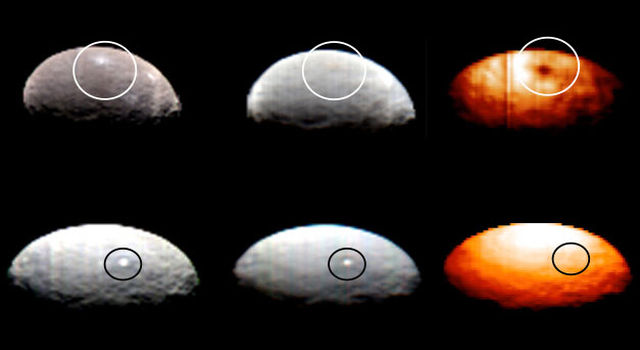
Ceres' surface is heavily cratered, as expected, but appears to have fewer large craters than scientists anticipated. It also has a pair of very bright neighboring spots in its northern hemisphere. More detail will emerge after the spacecraft begins its first intensive science phase on April 23, from a distance of 8,400 miles (13,500 kilometers) from the surface, said Martin Hoffmann, investigator on the Dawn framing camera team, based at the Max Planck Institute for Solar System Research, Göttingen, Germany.
The visible and infrared mapping spectrometer (VIR), an imaging spectrometer that examines Ceres in visible and infrared light, has been examining the relative temperatures of features on Ceres' surface. Preliminary examination suggests that different bright regions on Ceres' surface behave differently, said Federico Tosi, investigator from the VIR instrument team at the Institute for Space Astrophysics and Planetology, and the Italian National Institute for Astrophysics, Rome.
Based on observations from NASA's Hubble Space Telescope, planetary scientists have identified 10 bright regions on Ceres' surface. One pair of bright spots, by far the brightest visible marks on Ceres, appears to be located in a region that is similar in temperature to its surroundings. But a different bright feature corresponds to a region that is cooler than the rest of Ceres' surface.
The origins of Ceres' bright spots, which have captivated the attention of scientists and the public alike, remain unknown. It appears the brightest pair is located in a crater 57 miles (92 kilometers) wide. As Dawn gets closer to the surface of Ceres, better-resolution images will become available.
"The bright spots continue to fascinate the science team, but we will have to wait until we get closer and are able to resolve them before we can determine their source," Russell said.
Both Vesta and Ceres are located in the main asteroid belt between Mars and Jupiter. The Dawn spacecraft will continue studying Ceres through June 2016.

Monday, 19 August 2013

NASA's Dawn Prepares for Trek Toward Dwarf Planet - DAWN Sets Off For Ceres

PASADENA, Calif. – NASA's Dawn spacecraft is on track to become the first probe to orbit and study two distant solar system destinations, to help scientists answer questions about the formation of our solar system. The spacecraft is scheduled to leave the giant asteroid Vesta on Sept. 4 PDT (Sept. 5 EDT) to start its two-and-a-half-year journey to the dwarf planet Ceres.

Dawn began its 3-billion-mile (5-billion kilometer) odyssey to explore the two most massive objects in the main asteroid belt in 2007. Dawn arrived at Vesta in July 2011 and will reach Ceres in early 2015. Dawn's targets represent two icons of the asteroid belt that have been witness to much of our solar system's history.

To make its escape from Vesta, the spacecraft will spiral away as gently as it arrived, using a special, hyper-efficient system called ion propulsion. Dawn's ion propulsion system uses electricity to ionize xenon to generate thrust. The 12-inch-wide ion thrusters provide less power than conventional engines, but can maintain thrust for months at a time.

"Thrust is engaged, and we are now climbing away from Vesta atop a blue-green pillar of xenon ions," said Marc Rayman, Dawn's chief engineer and mission director, at NASA's Jet Propulsion Laboratory, Pasadena, Calif. "We are feeling somewhat wistful about concluding a fantastically productive and exciting exploration of Vesta, but now have our sights set on dwarf planet Ceres.

Dawn's orbit provided close-up views of Vesta, revealing unprecedented detail about the giant asteroid. The mission revealed that Vesta completely melted in the past, forming a layered body with an iron core. The spacecraft also revealed the scarring from titanic collisions Vesta suffered in its southern hemisphere, surviving not one but two colossal impacts in the last two billion years. Without Dawn, scientists would not have known about the dramatic troughs sculpted around Vesta, which are ripples from the two south polar impacts.

"We went to Vesta to fill in the blanks of our knowledge about the early history of our solar system," said Christopher Russell, Dawn's principal investigator, based at the University of California Los Angeles (UCLA). "Dawn has filled in those pages, and more, revealing to us how special Vesta is as a survivor from the earliest days of the solar system. We can now say with certainty that Vesta resembles a small planet more closely than a typical asteroid."