As NASA missions explore our solar system and search for new worlds, they are finding water in surprising places. Water is but one piece of our search for habitable planets and life beyond Earth, yet it links many seemingly unrelated worlds in surprising ways.
"NASA science activities have provided a wave of amazing findings related to water in recent years that inspire us to continue investigating our origins and the fascinating possibilities for other worlds, and life, in the universe," said Ellen Stofan, chief scientist for the agency. "In our lifetime, we may very well finally answer whether we are alone in the solar system and beyond."
The chemical elements in water, hydrogen and oxygen, are some of the most abundant elements in the universe. Astronomers see the signature of water in giant molecular clouds between the stars, in disks of material that represent newborn planetary systems, and in the atmospheres of giant planets orbiting other stars.
There are several worlds thought to possess liquid water beneath their surfaces, and many more that have water in the form of ice or vapor. Water is found in primitive bodies like comets and asteroids, and dwarf planets like Ceres. The atmospheres and interiors of the four giant planets -- Jupiter, Saturn, Uranus and Neptune -- are thought to contain enormous quantities of the wet stuff, and their moons and rings have substantial water ice.
Perhaps the most surprising water worlds are the five icy moons of Jupiter and Saturn that show strong evidence of oceans beneath their surfaces: Ganymede, Europa and Callisto at Jupiter, and Enceladus and Titan at Saturn.
Scientists using NASA's Hubble Space Telescope recently provided powerful evidence that Ganymede has a saltwater, sub-surface ocean, likely sandwiched between two layers of ice.
Europa and Enceladus are thought to have an ocean of liquid water beneath their surface in contact with mineral-rich rock, and may have the three ingredients needed for life as we know it: liquid water, essential chemical elements for biological processes, and sources of energy that could be used by living things. NASA's Cassini mission has revealed Enceladus as an active world of icy geysers. Recent research suggests it may have hydrothermal activity on its ocean floor, an environment potentially suitable for living organisms.
NASA spacecraft have also found signs of water in permanently shadowed craters on Mercury and our moon, which hold a record of icy impacts across the ages like cryogenic keepsakes.
While our solar system may seem drenched in some places, others seem to have lost large amounts of water.
On Mars, NASA spacecraft have found clear evidence that the Red Planet had water on its surface for long periods in the distant past. NASA's Curiosity Mars Rover discovered an ancient streambed that existed amidst conditions favorable for life as we know it.
More recently, NASA scientists using ground-based telescopes were able to estimate the amount of water Mars has lost over the eons. They concluded the planet once had enough liquid water to form an ocean occupying almost half of Mars' northern hemisphere, in some regions reaching depths greater than a mile (1.6 kilometers). But where did the water go?
It's clear some of it is in the Martian polar ice caps and below the surface. We also think much of Mars' early atmosphere was stripped away by the wind of charged particles that streams from the sun, causing the planet to dry out. NASA's MAVEN mission is hard at work following this lead from its orbit around Mars.
The story of how Mars dried out is intimately connected to how the Red Planet's atmosphere interacts with the solar wind. Data from the agency's solar missions -- including STEREO, Solar Dynamics Observatory and the planned Solar Probe Plus -- are vital to helping us better understand what happened.
Understanding the distribution of water in our solar system tells us a great deal about how the planets, moons, comets and other bodies formed 4.5 billion years ago from the disk of gas and dust that surrounded our sun. The space closer to the sun was hotter and drier than the space farther from the sun, which was cold enough for water to condense. The dividing line, called the "frost line," sat around Jupiter's present-day orbit. Even today, this is the approximate distance from the sun at which the ice on most comets begins to melt and become "active." Their brilliant spray releases water ice, vapor, dust and other chemicals, which are thought to form the bedrock of most worlds of the frigid outer solar system.
Scientists think it was too hot in the solar system's early days for water to condense into liquid or ice on the inner planets, so it had to be delivered -- possibly by comets and water-bearing asteroids. NASA's Dawn mission is currently studying Ceres, which is the largest body in the asteroid belt between Mars and Jupiter. Researchers think Ceres might have a water-rich composition similar to some of the bodies that brought water to the three rocky, inner planets, including Earth.
The amount of water in the giant planet Jupiter holds a critical missing piece to the puzzle of our solar system's formation. Jupiter was likely the first planet to form, and it contains most of the material that wasn't incorporated into the sun. The leading theories about its formation rest on the amount of water the planet soaked up. To help solve this mystery, NASA's Juno mission will measure this important quantity beginning in mid-2016.
Looking further afield, observing other planetary systems as they form is like getting a glimpse of our own solar system's baby pictures, and water is a big part of that story. For example, NASA's Spitzer Space Telescope has observed signs of a hail of water-rich comets raining down on a young solar system, much like the bombardment planets in our solar system endured in their youth.
With the study of exoplanets -- planets that orbit other stars -- we are closer than ever to finding out if other water-rich worlds like ours exist. In fact, our basic concept of what makes planets suitable for life is closely tied to water: Every star has a habitable zone, or a range of distances around it in which temperatures are neither too hot nor too cold for liquid water to exist. NASA's planet-hunting Kepler mission was designed with this in mind. Kepler looks for planets in the habitable zone around many types of stars.
Recently verifying its thousandth exoplanet, Kepler data confirm that the most common planet sizes are worlds just slightly larger than Earth. Astronomers think many of those worlds could be entirely covered by deep oceans. Kepler's successor, K2, continues to watch for dips in starlight to uncover new worlds.
The agency's upcoming TESS mission will search nearby, bright stars in the solar neighborhood for Earth- and super-Earth-sized exoplanets. Some of the planets TESS discovers may have water, and NASA's next great space observatory, the James Webb Space Telescope, will examine the atmospheres of those special worlds in great detail.
It's easy to forget that the story of Earth's water, from gentle rains to raging rivers, is intimately connected to the larger story of our solar system and beyond. But our water came from somewhere -- every world in our solar system got its water from the same shared source. So it's worth considering that the next glass of water you drink could easily have been part of a comet, or an ocean moon, or a long-vanished sea on the surface of Mars. And note that the night sky may be full of exoplanets formed by similar processes to our home world, where gentle waves wash against the shores of alien seas.
Monday, 27 July 2015

NASA's Curiosity Eyes Prominent Mineral Veins on Mars (April 2015)
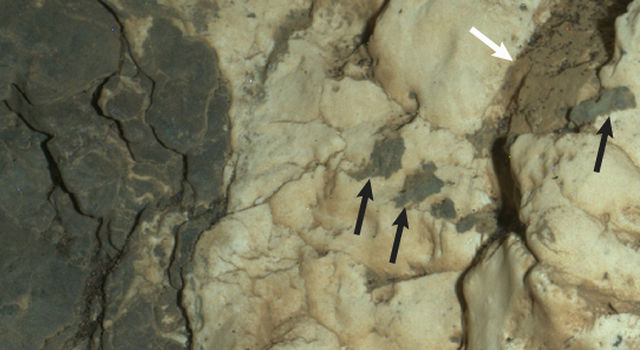
Two-tone mineral veins at a site NASA's Curiosity rover has reached by climbing a layered Martian mountain offer clues about multiple episodes of fluid movement. These episodes occurred later than the wet environmental conditions that formed lake-bed deposits the rover examined at the mountain's base.
Curiosity has analyzed rock samples drilled from three targets lower on the mountain in the past seven months. It found a different mineral composition at each, including a silica mineral named cristobalite in the most recent sample. These differences, together with the prominent veins seen in images taken a little farther uphill, illustrate how the layers of Mount Sharp provide a record of different stages in the evolution of the area's ancient environment.
The two-tone veins are at the site called "Garden City." They appear as a network of ridges left standing above the now eroded-away bedrock in which they formed. Individual ridges range up to about 2.5 inches (6 centimeters) high and half that in width, and they bear both bright and dark material.
"Some of them look like ice-cream sandwiches: dark on both edges and white in the middle," said Linda Kah, a Curiosity science-team member at the University of Tennessee, Knoxville. "These materials tell us about secondary fluids that were transported through the region after the host rock formed."
Veins such as these form where fluids move through cracked rock and deposit minerals in the fractures, often affecting the chemistry of the rock surrounding the fractures. Curiosity has found bright veins composed of calcium sulfate at several previous locations. The dark material preserved here presents an opportunity to learn more. Kah said, "At least two secondary fluids have left evidence here. We want to understand the chemistry of the different fluids that were here and the sequence of events. How have later fluids affected the host rock?"
Some of the sequence is understood: Mud that formed lake-bed mudstones Curiosity examined near its 2012 landing site and after reaching Mount Sharp must have dried and hardened before the fractures formed. The dark material that lines the fracture walls reflects an earlier episode of fluid flow than the white, calcium-sulfate-rich veins do, although both flows occurred after the cracks formed.
Garden City is about 39 feet (12 meters) higher than the bottom edge of the "Pahrump Hills" outcrop of the bedrock forming the basal layer of Mount Sharp, at the center of Mars' Gale Crater. The Curiosity mission spent about six months examining the first 33 feet (10 meters) of elevation at Pahrump Hills, climbing from the lower edge to higher sections three times to vertically profile the rock structures and chemistry, and to select the best targets for drilling.
"We investigated Pahrump Hills the way a field geologist would, looking over the whole outcrop first to choose the best samples to collect, and it paid off," said David Blake of NASA's Ames Research Center, Moffett Field, California, principal investigator for the Chemistry and Mineralogy (CheMin) analytical laboratory instrument inside the rover.
Analysis is still preliminary, but the three drilled samples from Pahrump Hills have clear differences in mineral ingredients. The first, "Confidence Hills," had the most clay minerals and hematite, both of which commonly form under wet conditions. The second, "Mojave," had the most jarosite, an oxidized mineral containing iron and sulfur that forms in acidic conditions. The third is "Telegraph Peak." Examination of Garden City has not included drilling a sample.
Blake said, "Telegraph Peak has almost no evidence of clay minerals, the hematite is nearly gone and jarosite abundance is down. The big thing about this sample is the huge amount of cristobalite, at about 10 percent or more of the crystalline material." Cristobalite is a mineral form of silica. The sample also contains a small amount of quartz, another form of silica. Among the possibilities are that some process removed other ingredients, leaving an enrichment of silica behind; or that dissolved silica was delivered by fluid transport; or that the cristobalite formed elsewhere and was deposited with the original sediment.
NASA's Mars Science Laboratory Project is using Curiosity to examine environments that offered favorable conditions for microbial life on ancient Mars, if the planet ever has hosted microbes, and the changes from those environments to drier conditions that have prevailed on Mars for more than three billion years.
After investigations in the Telegraph Peak area, the rover team plans to drive Curiosity through a valley called "Artist's Drive" to reach higher layers. Engineers are meanwhile developing guidelines for best use of the rover's drill, following detection of a transient short circuit last month while using the tool's percussion action to shake rock powder into a sample-processing device. Drilling can use both rotary and percussion actions.
Curiosity Sniffs Out History of Martian Atmosphere (April 2015)
NASA's Curiosity rover is using a new experiment to better understand the history of the Martian atmosphere by analyzing xenon.
While NASA's Curiosity rover concluded its detailed examination of the rock layers of the "Pahrump Hills" in Gale Crater on Mars this winter, some members of the rover team were busy analyzing the Martian atmosphere for xenon, a heavy noble gas.
Curiosity's Sample Analysis at Mars (SAM) experiment analyzed xenon in the planet's atmosphere. Since noble gases are chemically inert and do not react with other substances in the air or on the ground, they are excellent tracers of the history of the atmosphere. Xenon is present in the Martian atmosphere at a challengingly low quantity and can be directly measured only with on-site experiments such as SAM.
"Xenon is a fundamental measurement to make on a planet such as Mars or Venus, since it provides essential information to understand the early history of these planets and why they turned out so differently from Earth," said Melissa Trainer, one of the scientists analyzing the SAM data.
A planetary atmosphere is made up of different gases, which are in turn made up of variants of the same chemical element called isotopes. When a planet loses its atmosphere, that process can affect the ratios of remaining isotopes.
Measuring xenon tells us more about the history of the loss of the Martian atmosphere. The special characteristics of xenon - it exists naturally in nine different isotopes, ranging in atomic mass from 124 (with 70 neutrons per atom) to 136 (with 82 neutrons per atom) - allows us to learn more about the process by which the layers of atmosphere were stripped off Mars than using measurements of other gases.
A process removing gas from the top of the atmosphere removes lighter isotopes more readily than heavier ones, leaving a ratio higher in heavier isotopes than it was originally.
The SAM measurement of the ratios of the nine xenon isotopes traces a very early period in the history of Mars when a vigorous atmospheric escape process was pulling away even the heavy xenon gas. The lighter isotopes were escaping just a bit faster than the heavy isotopes.
Those escapes affected the ratio of isotopes in the atmosphere left behind, and the ratios today are a signature retained in the atmosphere for billions of years. This signature was first inferred several decades ago from isotope measurements on small amounts of Martian atmospheric gas trapped in rocks from Mars that made their way to Earth as meteorites.
"We are seeing a remarkably close match of the in-situ data to that from bits of atmosphere captured in some of the Martian meteorites," said SAM Deputy Principal Investigator Pan Conrad.
SAM previously measured the ratio of two isotopes of a different noble gas, argon. The results pointed to continuous loss over time of much of the original atmosphere of Mars.
The xenon experiment required months of careful testing at NASA's Goddard Space Flight Center in Greenbelt, Maryland, using a close copy of the SAM instrument enclosed in a chamber that simulates the Mars environment. This testing was led by Goddard's Charles Malespin, who developed and optimized the sequence of instructions for SAM to carry out on Mars.
"I'm gratified that we were able to successfully execute this run on Mars and demonstrate this new capability for Curiosity," said Malespin.
While NASA's Curiosity rover concluded its detailed examination of the rock layers of the "Pahrump Hills" in Gale Crater on Mars this winter, some members of the rover team were busy analyzing the Martian atmosphere for xenon, a heavy noble gas.
Curiosity's Sample Analysis at Mars (SAM) experiment analyzed xenon in the planet's atmosphere. Since noble gases are chemically inert and do not react with other substances in the air or on the ground, they are excellent tracers of the history of the atmosphere. Xenon is present in the Martian atmosphere at a challengingly low quantity and can be directly measured only with on-site experiments such as SAM.
"Xenon is a fundamental measurement to make on a planet such as Mars or Venus, since it provides essential information to understand the early history of these planets and why they turned out so differently from Earth," said Melissa Trainer, one of the scientists analyzing the SAM data.
A planetary atmosphere is made up of different gases, which are in turn made up of variants of the same chemical element called isotopes. When a planet loses its atmosphere, that process can affect the ratios of remaining isotopes.
Measuring xenon tells us more about the history of the loss of the Martian atmosphere. The special characteristics of xenon - it exists naturally in nine different isotopes, ranging in atomic mass from 124 (with 70 neutrons per atom) to 136 (with 82 neutrons per atom) - allows us to learn more about the process by which the layers of atmosphere were stripped off Mars than using measurements of other gases.
A process removing gas from the top of the atmosphere removes lighter isotopes more readily than heavier ones, leaving a ratio higher in heavier isotopes than it was originally.
The SAM measurement of the ratios of the nine xenon isotopes traces a very early period in the history of Mars when a vigorous atmospheric escape process was pulling away even the heavy xenon gas. The lighter isotopes were escaping just a bit faster than the heavy isotopes.
Those escapes affected the ratio of isotopes in the atmosphere left behind, and the ratios today are a signature retained in the atmosphere for billions of years. This signature was first inferred several decades ago from isotope measurements on small amounts of Martian atmospheric gas trapped in rocks from Mars that made their way to Earth as meteorites.
"We are seeing a remarkably close match of the in-situ data to that from bits of atmosphere captured in some of the Martian meteorites," said SAM Deputy Principal Investigator Pan Conrad.
SAM previously measured the ratio of two isotopes of a different noble gas, argon. The results pointed to continuous loss over time of much of the original atmosphere of Mars.
The xenon experiment required months of careful testing at NASA's Goddard Space Flight Center in Greenbelt, Maryland, using a close copy of the SAM instrument enclosed in a chamber that simulates the Mars environment. This testing was led by Goddard's Charles Malespin, who developed and optimized the sequence of instructions for SAM to carry out on Mars.
"I'm gratified that we were able to successfully execute this run on Mars and demonstrate this new capability for Curiosity," said Malespin.
Saturn Spacecraft Returns to the Realm of Icy Moons (March 2015)

Cassini's orbit will remain nearly equatorial for the remainder of 2015, during which the spacecraft will have four close encounters with Titan, two with Dione and three with the geyser-moon, Enceladus.
The two views of Rhea were taken about an hour-and-a-half apart on Feb. 9, 2015, when Cassini was about 30,000 to 50,000 miles (50,000 to 80,000 kilometers) away from the moon. Cassini officially began its new set of equatorial orbits on March 16.
The views show an expanded range of colors from those visible to human eyes in order to highlight subtle color variations across Rhea's surface. In natural color, the moon's surface is fairly uniform. The image at right represents the highest-resolution color view of Rhea released to date.
Scars on Mars from 2012 Rover Landing Fade -- Usually (March 2015)

The High Resolution Imaging Science Experiment (HiRISE) camera on NASA's Mars Reconnaissance Orbiter made the observations on multiple dates from landing to last month. After fading for about two years, the pace of change slowed and some of the scars may have even darkened again.
The images track changes in blast zones at four locations caused by different pieces of Curiosity hardware, such as the heat shield and the descent stage. The four series, each with images from five to seven different dates since landing, are available online at:
http://www.jpl.nasa.gov/spaceimages/details.php?id=PIA19159
"Spacecraft like Curiosity create these dark blast zone patterns where bright dust is blown away by the landing," said Ingrid Daubar, a HiRISE team scientist at NASA's Jet Propulsion Laboratory, Pasadena, California, who has used similar blast zones to find fresh meteor impact sites on Mars. "We expected to see them fade as the wind moved the dust around during the months and years after landing, but we've been surprised to see that the rate of change doesn't appear to be consistent."
One purpose for repeated follow-up imaging of Curiosity's landing area has been to check whether scientists could model the fading and predict how long it would take for the scars to disappear. Daubar's work on this aids preparations for NASA's next Mars lander, InSight, on track for launch in March 2016. The InSight mission will deploy a heat probe that will hammer itself a few yards, or meters, deep into the ground to monitor heat coming from the interior of the planet. The brightness of the ground affects temperature below ground, because a dark surface warms in sunshine more than a bright one does.
HiRISE is one of six instruments with which NASA's Mars Reconnaissance Orbiter has been studying Mars since 2006.
NASA's Mars Science Laboratory Project has been using the Curiosity rover to examine ancient Martian environments favorable for microbial life.
With three active NASA Mars orbiters and two Mars rovers, NASA seeks to characterize and understand Mars as a dynamic system, including its present and past environment, climate cycles, geology and biological potential. In parallel on its journey to Mars, NASA is developing the capabilities needed for human missions there.
Astronomers Upgrade Their Cosmic Light Bulbs (March 2015)

The brilliant explosions of dead stars have been used for years to illuminate the far-flung reaches of our cosmos. The explosions, called Type Ia supernovae, allow astronomers to measure the distances to galaxies and measure the ever-increasing rate at which our universe is stretching apart.
But these tools aren't perfect. In the cosmic hardware store of our universe, improvements are ongoing. In a new report, appearing March 27 in the journal Science, astronomers identify the best, top-of-the-line Type Ia supernovae for measuring cosmic distances, pushing other, more clunky tools to the back of the shelf.
Using archived data from NASA's Galaxy Evolution Explorer (GALEX), scientists show that a particular class of Type Ia supernovae that occur near youthful stars can improve these measurements with a precision of more than two times that achieved before.
"We have discovered a population of Type Ia supernovae whose light output depends very precisely on how quickly they fade, making it possible to measure very exact distances to them," said Patrick Kelly of the University of California, Berkeley, lead author of the new study. "These supernovae are found close to populations of bright, hot young stars."
The findings will help light the way to understanding dark energy, one of the greatest mysteries in the field of cosmology, the study of the origin and development of the universe. Dark energy is the leading culprit behind the baffling acceleration of our cosmos, a phenomenon discovered in 1998. The acceleration was uncovered when astronomers observed that galaxies are pulling away from each other at increasing speeds.
The key to measuring this acceleration -- and thus the nature of dark energy -- lies with Type Ia supernovae, which work much like light bulbs strung across space. Imagine lining up 60-watt light bulbs across a field and standing at one end. The farthest light bulb wouldn't appear as bright as the closest one due to its distance. Since you know how bright the light bulb inherently is, you can use the extent of its dimming to figure out the distance.
Type Ia supernovae, also referred to as "standard candles," work in a similar way because they consistently shine with about the same amount of light. While the process that leads to these explosions is still not clear, they occur when the burnt-out core of a star, called a white dwarf, blasts apart in a regular way, briefly lighting up the host galaxy.
However, the explosions aren't always precisely uniform. They can differ considerably depending on various factors, which appear to be connected to the environments and histories of the exploding stars. It's as if our 60-watt bulbs sometimes give off 55 watts of light, skewing distance measurements.
Kelly and his team investigated the reliability of these tools by analyzing the surroundings of nearly 100 previous Type Ia explosions. They used data from GALEX, which detects ultraviolet light. Populations of hot, young stars in galaxies will shine brightly with ultraviolet light, so GALEX can distinguish between young and older star-forming communities.
The results showed that the Type Ia supernovae affiliated with the hot, young stars were significantly more reliable at indicating distances than their counterparts.
"These explosions are likely the result of youthful white dwarfs," said Kelly.
By focusing on this particular brand of Type Ia tools, astronomers will be able to, in the future, make even sharper measurements of the size and scale of our universe. According to the science team, this class of tools could work at distances up to six billion light-years away, and perhaps farther.
"GALEX surveyed the entire sky, allowing past and future eruptions of these high-quality standard candles to be identified easily," said Don Neill, a member of the GALEX team at the California Institute of Technology in Pasadena, not affiliated with the study. "Any improvement in the standard candles will have a direct impact on theories of dark energy, allowing us to home in on this mysterious force propelling the acceleration of the universe."
Caltech led the Galaxy Evolution Explorer mission and was responsible for science operations and data analysis. The mission ended in 2013 after more than a decade of scanning the skies in ultraviolet light. NASA's Jet Propulsion Laboratory in Pasadena, California, managed the mission and built the science instrument. The mission was developed under NASA's Explorers Program managed by the Goddard Space Flight Center, Greenbelt, Maryland. Researchers sponsored by Yonsei University in South Korea and the Centre National d'Etudes Spatiales (CNES) in France collaborated on this mission. ?
Curiosity Rover Finds Biologically Useful Nitrogen on Mars
A team using the Sample Analysis at Mars (SAM) instrument suite aboard NASA's Curiosity rover has made the first detection of nitrogen on the surface of Mars from release during heating of Martian sediments.
The nitrogen was detected in the form of nitric oxide, and could be released from the breakdown of nitrates during heating. Nitrates are a class of molecules that contain nitrogen in a form that can be used by living organisms. The discovery adds to the evidence that ancient Mars was habitable for life.
Nitrogen is essential for all known forms of life, since it is used in the building blocks of larger molecules like DNA and RNA, which encode the genetic instructions for life, and proteins, which are used to build structures like hair and nails, and to speed up or regulate chemical reactions.
However, on Earth and Mars, atmospheric nitrogen is locked up as nitrogen gas (N2) - two atoms of nitrogen bound together so strongly that they do not react easily with other molecules. The nitrogen atoms have to be separated or "fixed" so they can participate in the chemical reactions needed for life. On Earth, certain organisms are capable of fixing atmospheric nitrogen and this process is critical for metabolic activity. However, smaller amounts of nitrogen are also fixed by energetic events like lightning strikes.
Nitrate (NO3) - a nitrogen atom bound to three oxygen atoms - is a source of fixed nitrogen. A nitrate molecule can join with various other atoms and molecules; this class of molecules is known as nitrates.
There is no evidence to suggest that the fixed nitrogen molecules found by the team were created by life. The surface of Mars is inhospitable for known forms of life. Instead, the team thinks the nitrates are ancient, and likely came from non-biological processes like meteorite impacts and lightning in Mars' distant past.
Features resembling dry riverbeds and the discovery of minerals that form only in the presence of liquid water suggest that Mars was more hospitable in the remote past. The Curiosity team has found evidence that other ingredients needed for life, such as liquid water and organic matter, were present on Mars at the Curiosity site in Gale Crater billions of years ago.
"Finding a biochemically accessible form of nitrogen is more support for the ancient Martian environment at Gale Crater being habitable," said Jennifer Stern of NASA's Goddard Space Flight Center in Greenbelt, Maryland. Stern is lead author of a paper on this research published online in the Proceedings of the National Academy of Science March 23.
The team found evidence for nitrates in scooped samples of windblown sand and dust at the "Rocknest" site, and in samples drilled from mudstone at the "John Klein" and "Cumberland" drill sites in Yellowknife Bay. Since the Rocknest sample is a combination of dust blown in from distant regions on Mars and more locally sourced materials, the nitrates are likely to be widespread across Mars, according to Stern. The results support the equivalent of up to 1,100 parts per million nitrates in the Martian soil from the drill sites. The team thinks the mudstone at Yellowknife Bay formed from sediment deposited at the bottom of a lake. Previously the rover team described the evidence for an ancient, habitable environment there: fresh water, key chemical elements required by life, such as carbon, and potential energy sources to drive metabolism in simple organisms.
The samples were first heated to release molecules bound to the Martian soil, then portions of the gases released were diverted to the SAM instruments for analysis. Various nitrogen-bearing compounds were identified with two instruments: a mass spectrometer, which uses electric fields to identify molecules by their signature masses, and a gas chromatograph, which separates molecules based on the time they take to travel through a small glass capillary tube -- certain molecules interact with the sides of the tube more readily and thus travel more slowly.
Along with other nitrogen compounds, the instruments detected nitric oxide (NO -- one atom of nitrogen bound to an oxygen atom) in samples from all three sites. Since nitrate is a nitrogen atom bound to three oxygen atoms, the team thinks most of the NO likely came from nitrate which decomposed as the samples were heated for analysis. Certain compounds in the SAM instrument can also release nitrogen as samples are heated; however, the amount of NO found is more than twice what could be produced by SAM in the most extreme and unrealistic scenario, according to Stern. This leads the team to think that nitrates really are present on Mars, and the abundance estimates reported have been adjusted to reflect this potential additional source.
"Scientists have long thought that nitrates would be produced on Mars from the energy released in meteorite impacts, and the amounts we found agree well with estimates from this process," said Stern.
The nitrogen was detected in the form of nitric oxide, and could be released from the breakdown of nitrates during heating. Nitrates are a class of molecules that contain nitrogen in a form that can be used by living organisms. The discovery adds to the evidence that ancient Mars was habitable for life.
Nitrogen is essential for all known forms of life, since it is used in the building blocks of larger molecules like DNA and RNA, which encode the genetic instructions for life, and proteins, which are used to build structures like hair and nails, and to speed up or regulate chemical reactions.
However, on Earth and Mars, atmospheric nitrogen is locked up as nitrogen gas (N2) - two atoms of nitrogen bound together so strongly that they do not react easily with other molecules. The nitrogen atoms have to be separated or "fixed" so they can participate in the chemical reactions needed for life. On Earth, certain organisms are capable of fixing atmospheric nitrogen and this process is critical for metabolic activity. However, smaller amounts of nitrogen are also fixed by energetic events like lightning strikes.
Nitrate (NO3) - a nitrogen atom bound to three oxygen atoms - is a source of fixed nitrogen. A nitrate molecule can join with various other atoms and molecules; this class of molecules is known as nitrates.
There is no evidence to suggest that the fixed nitrogen molecules found by the team were created by life. The surface of Mars is inhospitable for known forms of life. Instead, the team thinks the nitrates are ancient, and likely came from non-biological processes like meteorite impacts and lightning in Mars' distant past.
Features resembling dry riverbeds and the discovery of minerals that form only in the presence of liquid water suggest that Mars was more hospitable in the remote past. The Curiosity team has found evidence that other ingredients needed for life, such as liquid water and organic matter, were present on Mars at the Curiosity site in Gale Crater billions of years ago.
"Finding a biochemically accessible form of nitrogen is more support for the ancient Martian environment at Gale Crater being habitable," said Jennifer Stern of NASA's Goddard Space Flight Center in Greenbelt, Maryland. Stern is lead author of a paper on this research published online in the Proceedings of the National Academy of Science March 23.
The team found evidence for nitrates in scooped samples of windblown sand and dust at the "Rocknest" site, and in samples drilled from mudstone at the "John Klein" and "Cumberland" drill sites in Yellowknife Bay. Since the Rocknest sample is a combination of dust blown in from distant regions on Mars and more locally sourced materials, the nitrates are likely to be widespread across Mars, according to Stern. The results support the equivalent of up to 1,100 parts per million nitrates in the Martian soil from the drill sites. The team thinks the mudstone at Yellowknife Bay formed from sediment deposited at the bottom of a lake. Previously the rover team described the evidence for an ancient, habitable environment there: fresh water, key chemical elements required by life, such as carbon, and potential energy sources to drive metabolism in simple organisms.
The samples were first heated to release molecules bound to the Martian soil, then portions of the gases released were diverted to the SAM instruments for analysis. Various nitrogen-bearing compounds were identified with two instruments: a mass spectrometer, which uses electric fields to identify molecules by their signature masses, and a gas chromatograph, which separates molecules based on the time they take to travel through a small glass capillary tube -- certain molecules interact with the sides of the tube more readily and thus travel more slowly.
Along with other nitrogen compounds, the instruments detected nitric oxide (NO -- one atom of nitrogen bound to an oxygen atom) in samples from all three sites. Since nitrate is a nitrogen atom bound to three oxygen atoms, the team thinks most of the NO likely came from nitrate which decomposed as the samples were heated for analysis. Certain compounds in the SAM instrument can also release nitrogen as samples are heated; however, the amount of NO found is more than twice what could be produced by SAM in the most extreme and unrealistic scenario, according to Stern. This leads the team to think that nitrates really are present on Mars, and the abundance estimates reported have been adjusted to reflect this potential additional source.
"Scientists have long thought that nitrates would be produced on Mars from the energy released in meteorite impacts, and the amounts we found agree well with estimates from this process," said Stern.
Subscribe to:
Posts (Atom)