Saturday, 6 March 2010

US Large Hydron Smashes Gold to Create "Quark Soup"


Computer simulations of the lab work, clockwise from top left: Gluons and quarks; gold ions about to collide; just after the collision; the resulting perfect liquid. Credit: RHIC
WASHINGTON – By smashing gold particles together at super-fast speeds, physicists have basically melted protons, creating a kind of "quark soup" of matter that is about 250,000 times hotter than the center of the sun and similar to conditions just after the birth of the universe.Scientists reported in 2005 that they suspected they had created this unique state of matter, but for the first time they have verified that the extreme temperatures necessary have been reached.

"This is the hottest matter ever created in the laboratory," Steven Vigdor, associate laboratory director for nuclear and particle physics at the U.S. Department of Energy (DOE)'s Brookhaven National Laboratory in Upton, N.Y., said Monday at a meeting of the American Physical Society in Washington, D.C. "The temperature is hot enough to melt protons and neutrons."

The gold particles used in the experiment were only the nuclei — the positively-charged part of the atom made of protons and neutrons. Two sprays of gold nuclei were accelerated in opposite directions along a circular track in an underground "atom smasher" called the Relativistic Heavy Ion Collider (RHIC) Brookhaven.


These scorching conditions are enough to melt the protons and neutrons into their constituent parts — namely fundamental particles called quarks and gluons.

This soup of quarks and gluons is thought to have filled the universe a few microseconds after the Big Bang that may have created it about 13.7 billion years ago. After that point, the matter would have cooled and condensed to form the protons and neutrons that make up the matter we see today.

"This research offers significant insight into the fundamental structure of matter and the early universe, highlighting the merits of long-term investment in large-scale, basic research programs at our national laboratories," said Dr. William F. Brinkman, director of the DOE Office of Science. "I commend the careful approach RHIC scientists have used to gather detailed evidence for their claim of creating a truly remarkable new form of matter."

The soupy cauldron of fundamental particles lasted less than a billionth of a trillionth of a second. But that was enough time for physicists to measure its properties and temperature using a detector built around the collision site.

The temperature measurements came via photons, or bits of light, that were emitted shortly after the nuclei crashed into each other.

"This was an extraordinarily challenging measurement," said Barbara Jacak, a professor of physics at Stony Brook University in Stony Brook, N.Y. and spokesperson for the PHENIX collaboration, one of RHIC's four experiments.

Somewhat surprisingly, the strange state of matter behaves like a liquid, though earlier predictions suggested it would act more like a gas.

"We know that this is a liquid, but we need to find out why it's a liquid, and what role did its free-flowing nature play in the early universe?" Jacak said.

Physicists may have a chance to study an even hotter state of matter once the world's largest particle accelerator, the Large Hadron Collider near Geneva, Switzerland, starts operating at full speed. Collisions in that machine could produce temperatures two or three times hotter than the recent experiment, Jacak said.

Wednesday, 24 February 2010

The Solar System - 4 Billion Miles Out and 32 deg Above The Eliptic


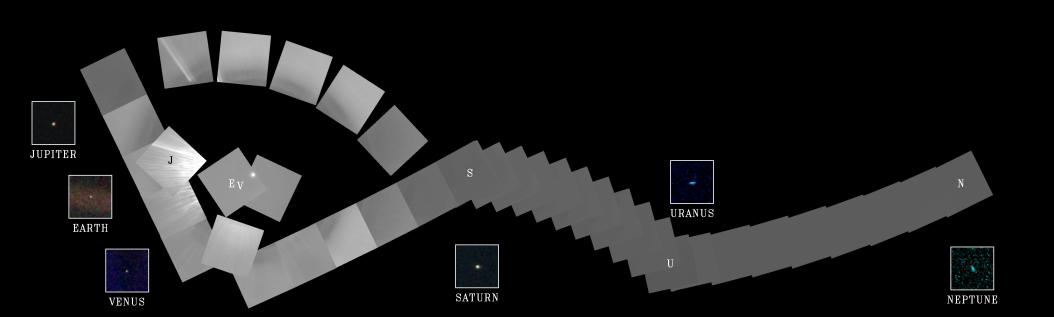
The cameras of Voyager 1 on Feb. 14, 1990, pointed back toward the sun and took a series of pictures of the sun and the planets, making the first ever "portrait" of our solar system as seen from the outside. In the course of taking this mosaic consisting of a total of 60 frames, Voyager 1 made several images of the inner solar system from a distance of approximately 4 billion miles and about 32 degrees above the ecliptic plane. Thirty-nine wide angle frames link together six of the planets of our solar system in this mosaic. Outermost Neptune is 30 times further from the sun than Earth. Our sun is seen as the bright object in the center of the circle of frames. The wide-angle image of the sun was taken with the camera's darkest filter (a methane absorption band) and the shortest possible exposure (5 thousandths of a second) to avoid saturating the camera's vidicon tube with scattered sunlight. The sun is not large as seen from Voyager, only about one-fortieth of the diameter as seen from Earth, but is still almost 8 million times brighter than the brightest star in Earth's sky, Sirius. The result of this great brightness is an image with multiple reflections from the optics in the camera. Wide-angle images surrounding the sun also show many artifacts attributable to scattered light in the optics. These were taken through the clear filter with one second exposures. The insets show the planets magnified many times. Narrow-angle images of Earth, Venus, Jupiter, Saturn, Uranus and Neptune were acquired as the spacecraft built the wide-angle mosaic. Jupiter is larger than a narrow-angle pixel and is clearly resolved, as is Saturn with its rings. Uranus and Neptune appear larger than they really are because of image smear due to spacecraft motion during the long (15 second) exposures. From Voyager's great distance Earth and Venus are mere points of light, less than the size of a picture element even in the narrow-angle camera. Earth was a crescent only 0.12 pixel in size. Coincidentally, Earth lies right in the center of one of the scattered light rays resulting from taking the image so close to the sun.

Layers in a Mars Crater Record a History of Changes


February 11, 2010

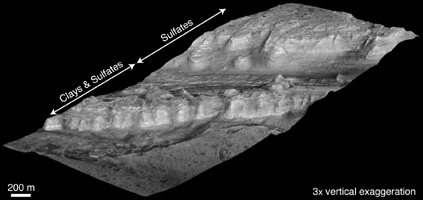
PASADENA, Calif. -- Near the center of a Martian crater about the size of Connecticut, hundreds of exposed rock layers form a mound as tall as the Rockies and reveal a record of major environmental changes on Mars billions of years ago.

The history told by this tall parfait of layers inside Gale Crater matches what has been proposed in recent years as the dominant planet-wide pattern for early Mars, according to a new report by geologists using instruments on NASA's Mars Reconnaissance Orbiter.

"Looking at the layers from the bottom to the top, from the oldest to the youngest, you see a sequence of changing rocks that resulted from changes in environmental conditions through time," said Ralph Milliken of NASA's Jet Propulsion Laboratory, Pasadena, Calif. "This thick sequence of rocks appears to be showing different steps in the drying-out of Mars."

Using geological layers to understand stages in the evolution of a planet's climate has a precedent on Earth. A change about 1.8 billion years ago in the types of rock layers formed on Earth became a key to understanding a dramatic change in Earth's ancient atmosphere.

Milliken and two co-authors report in Geophysical Research Letters that clay minerals, which form under very wet conditions, are concentrated in layers near the bottom of the Gale stack. Above that, sulfate minerals are intermixed with the clays. Sulfates form in wet conditions and can be deposited when the water in which they are dissolved evaporates. Higher still are sulfate-containing layers without detectable clays. And at the top is a thick formation of regularly spaced layers bearing no detectable water-related minerals.

Rock exposures with compositions like various layers of the Gale stack have been mapped elsewhere on Mars, and researchers, including Jean-Pierre Bibring of the University of Paris, have proposed a Martian planetary chronology of clay-producing conditions followed by sulfate-producing conditions followed by dry conditions. However, Gale is the first location where a single series of layers has been found to contain these clues in a clearly defined sequence from older rocks to younger rocks.

"If you could stand there, you would see this beautiful formation of Martian sediments laid down in the past, a stratigraphic section that's more than twice the height of the Grand Canyon, though not as steep," said Bradley Thomson of the Johns Hopkins University Applied Physics Laboratory, Laurel, Md. He and John Grotzinger of the California Institute of Technology in Pasadena are Milliken's co-authors.

NASA selected Gale Crater in 2008 as one of four finalist sites for the Mars Science Laboratory rover, Curiosity, which has a planned launch in 2011. The finalist sites all have exposures of water-related minerals, and each has attributes that distinguish it from the others. This new report is an example of how observations made for evaluating the landing-site candidates are providing valuable science results even before the rover mission launches.

Three instruments on NASA's Mars Reconnaissance Orbiter have provided key data about the layered mound in Gale Crater. Images from the High Resolution Imaging Science Experiment camera reveal details used to map hundreds of layers. Using stereo pairs of the images, the U.S. Geological Survey has generated three-dimensional models used to discern elevation differences as small as a meter (about a yard). Observations by the Compact Reconnaissance Imaging Spectrometer for Mars yielded information about minerals on the surface. The Context Camera provided broader-scale images showing how the layers fit geologically into their surroundings.

Thomson said, "This work demonstrates the synergy of the instruments on the Mars Reconnaissance Orbiter. We wouldn't have as complete a picture if we were missing any of the components."

The mission has been studying Mars since 2006. It has returned more data from the planet than all other Mars missions combined. More information about this mission is at http://www.nasa.gov/mro.

Dwarf Galaxies Provide Clues to Early Star Formation in Universe


An astronomer at Lowell Observatory studies how stars form in tiny, "dwarf" galaxies, which may provide insight into the birth of the first starts after the Big Bang. Here, a color-enhanced optical image of the galaxy DDO 87 in the constellation Ursa Major that shows the stars. Credit: Lowell Observatory.


Full Story..........

When you picture a galaxy in your mind's eye, it's often a spiral with magnificent structure — long, swirling, milky-white arms of stars and gas.
Lowell Observatory astronomer Deidre Hunter has spent most the last 17 years methodically studying unfamiliar galaxies that you might not expect — small, diffuse galaxies: the dwarf irregulars — to learn all she can about star formation and what it can tell her and her colleagues about the birth of the first stars after the Big Bang.

In an NSF-funded project called LITTLE THINGS — for Local Irregulars That Trace Luminosity Extremes (LITTLE) and The HI Nearby Galaxy Survey (THINGS) — Hunter's team is mapping the gasses in these diffuse, enigmatic galaxies to discern the many processes of star formation.

The LITTLE THINGS team is closely studying 41 dwarf-irregular galaxies through the lens of numerous data sets. And the galaxies are small, relatively speaking. One, DDO 75, has 1/3500 the mass of the Milky Way. Another, Leo T, was recently discovered in the Local Group of galaxies, the closest neighbors to our own Milky Way.

"Leo T is comparable in brightness to a large star cluster that contains several million stars; in contrast, the Milky Way contains about 300 billion stars," Hunter said. Some of the galaxies in our sample area are not much brighter than a large star cluster."

The process of star formation is very inefficient. Some 50 to 90 percent of the gas present in star-forming molecular clouds, including the gas in the tiny irregular galaxies, remains after stars form.
"This produces the nebulae," Hunter said. "They are like signposts that say, 'massive stars are found here.' In a general sense it's like weather clouds on Earth. You need these molecular clouds that form out of the ubiquitous atomic hydrogen gas to precipitate stars."
Hunter added that there are probably multiple processes going on, which adds to the complexity and time-intensive nature of the LITTLE THINGS study. In the dwarf galaxies, there's star-induced star formation. There's also turbulence. "It's not just density, but also the motions of the gas," Hunter says.

The data sets Hunter and her colleagues are using include optical-wavelength data Hunter already collected and analyzed using research telescopes at Lowell’s Anderson Mesa facility near Flagstaff. But some of the new, key data is in radio wavelengths, and they come from NSF's Very Large Array (VLA) located west of Socorro, New Mexico.
In May of 2007, Hunter was invited to give a talk at the VLA. Afterwards, a scientist with the facility suggested she put in a large proposal, that is, a proposal for a large amount of VLA telescope time. She and her team had been unsuccessful in previous smaller requests for the needed hours, but this time, the team was rewarded: about 400 hours to study a subsample of dwarf galaxies that represent a range of characteristics.
One of Hunter's collaborators, Lowell predoctoral student Megan Jackson, is looking at the motions of the stars, their velocities, and their rotation. Fellow Lowell predoc Hongxin Zhang is looking closely at existing ultraviolet and optical data sets from the galaxies, helping define their star-formation histories.

Zhang has been limited with his current sets of infrared data, so he is embarking on an observing program using a special instrument called Mimir attached to the 1.8-meter Perkins Telescope at Anderson Mesa, also at Lowell. The Perkins is operated through a partnership with Boston University, and Mimir is a powerful, $2.5-millon infrared instrument built by a team led by Dan Clemens of Boston University.
As for the massive amount of VLA radio data, much has to be collected, sorted, and analyzed. Kim Herrmann, a Lowell Observatory postdoctoral fellow, is part of the LITTLE THINGS team and she is reducing the VLA data.
"When Kim came to Flagstaff, she had never dealt with radio interferometric data," Hunter said. "But she quickly came up to speed and has now become a local expert. She has calibrated more LITTLE THINGS data than any other person on the team, and she is exactly the kind of person we need on the team. Right now, we're in this grunge phase of the project; it is very tedious. If all goes well, and I'm not distracted by other tasks, it takes me one month per galaxy to reduce the VLA data."
The extensive data are poised to re-shape astronomers' understanding of star formation. "The crux of the problem is that the standard models for galaxies don't work for dwarfs. Dwarfs should not be forming stars at all."

But indeed they are. They are forming stars even at their outer edges. The little-understood portions of dwarf irregular galaxies are what intrigue Hunter most of all.
"It's the outer disks — because they are so extreme," she said. "These are such extreme environments that they are very stringent tests for star formation."


Small Ground-Based Telescope Detects Exo-Planet Atmosphere

February 03, 2010


NASA astronomers have successfully demonstrated that a David of a telescope can tackle Goliath-size questions in the quest to study Earth-like planets around other stars. Their work, reported today in the journal Nature, provides a new tool for ground-based observatories, promising to accelerate by years the search for prebiotic, or life-related, molecules on planets orbiting stars beyond our solar system.

The scientists reported on a new technique used with a relatively small Earth-based telescope to identify an organic molecule in the atmosphere of a Jupiter-size planet nearly 63 light-years away. The measurement revealed details of the exoplanet's atmospheric composition and conditions, an unprecedented achievement from an Earth-based observatory.

The surprising new finding comes from a venerable 30-year-old, 3-meter-diameter (10-foot) telescope that ranks 40th among ground-based telescopes - NASA's Infrared Telescope Facility atop Mauna Kea, Hawaii.

The new technique promises to further speed the work of studying planet atmospheres by enabling studies from the ground that were previously possible only through a few very high-performance space telescopes. "Given favorable observing conditions, this work suggests we may be able to detect organic molecules in the atmospheres of terrestrial planets with existing instruments," said lead author Mark Swain, an astronomer at NASA's Jet Propulsion Laboratory, Pasadena, Calif. This can allow fast and economical advances in focused studies of exoplanet atmospheres, accelerating our understanding of the growing stable of exoplanets.

"The fact that we have used a relatively small, ground-based telescope is exciting because it implies that the largest telescopes on the ground, using this technique, may be able to characterize terrestrial exoplanet targets," Swain said.

Currently, more than 400 exoplanets are known. Most are gaseous like Jupiter, but some "super-Earths" are thought to be large terrestrial, or rocky, worlds. A true Earth-like planet, with the same size as our planet and distance from its star, has yet to be discovered. NASA's Kepler mission is searching from space now, and is expected to find several of these earthly worlds by the end of its three-and-a-half-year prime mission.

On Aug. 11, 2007, Swain and his team turned the infrared telescope to the hot, Jupiter-size planet HD 189733b in the constellation Vulpecula. Every 2.2 days, the planet orbits a K-type main sequence star slightly cooler and smaller than our sun. HD189733b had already yielded breakthrough advances in exoplanet science, including detections of water vapor, methane and carbon dioxide, using space telescopes. Using the new technique, the astronomers successfully detected carbon dioxide and methane in the atmosphere of HD 189733b with a spectrograph, which splits light into its components to reveal the distinctive spectral signatures of different chemicals. Their key work was development of a novel calibration method to remove systematic observation errors caused by the variability of Earth's atmosphere and instability due to the movement of the telescope system as it tracks its target.

"As a consequence of this work, we now have the exciting prospect that other suitably equipped yet relatively small ground-based telescopes should be capable of characterizing exoplanets," said John Rayner, the NASA Infrared Telescope Facility support scientist who built the SpeX spectrograph used for these measurements. "On some days we can't even see the sun with the telescope, and the fact that on other days we can now obtain a spectrum of an exoplanet 63 light-years away is astonishing."

In the course of their observations, the team found unexpected bright infrared emission from methane that stands out on the day side of HD189733b, indicating some kind of activity in the planet's atmosphere. Swain said this puzzling feature could be related to the effect of ultraviolet radiation from the planet's parent star hitting the planet's upper atmosphere, but more detailed study is needed. "This feature indicates the surprises that await us as we study exoplanet atmospheres," he added.

"An immediate goal for using this technique is to more fully characterize the atmosphere of this and other exoplanets, including detection of organic and possibly prebiotic molecules" like those that preceded the evolution of life on Earth, said Swain. "We're ready to undertake that task." Some early targets will be the super-Earths. Used in synergy with observations from NASA's Hubble, Spitzer and the future James Webb Space Telescope, the new technique "will give us an absolutely brilliant way to characterize super-Earths," Swain said.

Cassini Captures Ghostly Dance Of Saturn's Northern Lights


Go to this page to see video Saturn "Northern Lights"

November 24, 2009


PASADENA, Calif. – In the first video showing the auroras above the northern latitudes of Saturn, Cassini has spotted the tallest known "northern lights" in the solar system, flickering in shape and brightness high above the ringed planet.

The new video reveals changes in Saturn's aurora every few minutes, in high resolution, with three dimensions. The images show a previously unseen vertical profile to the auroras, which ripple in the video like tall curtains. These curtains reach more than 1,200 kilometers (750 miles) above the edge of the planet's northern hemisphere.

The new video and still images are online at: http://www.nasa.gov/cassini , http://saturn.jpl.nasa.gov and http://ciclops.org .

Auroras occur on Earth, Jupiter, Saturn and a few other planets, and the new images will help scientists better understand how they are generated.

"The auroras have put on a dazzling show, shape-shifting rapidly and exposing curtains that we suspected were there, but hadn't seen on Saturn before," said Andrew Ingersoll of the California Institute of Technology in Pasadena, who is a member of the Cassini imaging team that processed the new video. "Seeing these things on another planet helps us understand them a little better when we see them on Earth."

Auroras appear mostly in the high latitudes near a planet's magnetic poles. When charged particles from the magnetosphere -- the magnetic bubble surrounding a planet -- plunge into the planet's upper atmosphere, they cause the atmosphere to glow. The curtain shapes show the paths that these charged particles take as they flow along the lines of the magnetic field between the magnetosphere and the uppermost part of the atmosphere.

The height of the curtains on Saturn exposes a key difference between Saturn's atmosphere and our own, Ingersoll said. While Earth's atmosphere has a lot of oxygen and nitrogen, Saturn's atmosphere is composed primarily of hydrogen. Because hydrogen is very light, the atmosphere and auroras reach far out from Saturn. Earth's auroras tend to flare only about 100 to 500 kilometers (60 to 300 miles) above the surface.

The speed of the auroral changes in the video is comparable to some of those on Earth, but scientists are still working to understand the processes that produce these rapid changes. The height will also help them learn how much energy is required to light up auroras.

"I was wowed when I saw these images and the curtain," said Tamas Gombosi of the University of Michigan in Ann Arbor, who chairs Cassini's magnetosphere and plasma science working group. "Put this together with the other data Cassini has collected on the auroras so far, and you really get a new science."

Ultraviolet and infrared instruments on Cassini have captured images of and data from Saturn's auroras before, but in these latest images, Cassini's narrow-angle camera was able to capture the northern lights in the visible part of the light spectrum, in higher resolution. The movie was assembled from nearly 500 still pictures spanning 81 hours between Oct. 5 and Oct. 8, 2009. Each picture had an exposure time of two or three minutes. The camera shot pictures from the night side of Saturn.

The images were originally obtained in black and white, and the imaging team highlighted the auroras in false-color orange. The oxygen and nitrogen in Earth's upper atmosphere contribute to the colorful flashes of green, red and even purple in our auroras. But scientists are still working to determine the true color of the auroras at Saturn, whose atmosphere lacks those chemicals.